 Westminster House Clearance Health & Safety Policy
Scope and purpose: This Health and Safety policy outlines the commitment of Westminster House Clearance to protect employees, clients, contractors, visitors and the public while delivering professional house clearance and rubbish removal services. The policy applies to all operational activities, including domestic clear-outs, furniture and debris removal, disposal and recycling activities across our service area. It sets out responsibilities, risk control measures and monitoring arrangements to ensure safe, compliant waste handling and clearance work.
 Our objectives include preventing work-related injuries and ill health, reducing environmental impact from waste, ensuring safe vehicle and site operations, and promoting a culture of safety. Key commitments are: conducting and recording risk assessments; providing appropriate training and personal protective equipment (PPE); maintaining equipment and vehicles; managing hazardous materials safely; and reporting and investigating incidents. This policy emphasises safe working for both our clearance company staff and any subcontractors engaged on projects.
Responsibilities and accountability
Management is responsible for implementing and maintaining this policy, allocating adequate resources and ensuring legal compliance across all clearance services activities. Supervisors and team leaders must ensure day-to-day safety by enforcing safe systems of work, supervising manual handling, and ensuring staff use appropriate PPE. Individual employees are expected to follow safe working procedures, attend training, report hazards or near-misses promptly and cooperate with risk control measures. Contractors engaged for specialist tasks must demonstrate competence and provide evidence of their own safety arrangements.
 Risk assessment and control: before any clearance or rubbish collection job, a documented assessment will identify hazards such as manual handling risks, sharps and broken glass, asbestos suspicion, hazardous chemicals, rodent contamination, confined spaces, and traffic or access risks. Controls will include safe lifting techniques, the use of mechanical aids, segregation of recyclables, safe containment of hazardous items, and exclusion zones where necessary. Where asbestos or other controlled waste is suspected, work will stop and specialist removal arranged in line with regulations.
Training, competency and supervision
All staff will receive induction training covering company safety arrangements, waste segregation, manual handling, correct use of PPE and emergency procedures. Ongoing training will be provided for vehicle safety, secure loading, operating tail lifts and tippers, and handling clinical or hazardous waste only when authorised. Supervisors will carry out regular toolbox talks and competency checks. The company uses a documented training matrix to track qualifications and refresher schedules so that clearance teams remain competent for the variety of waste removal tasks they perform.
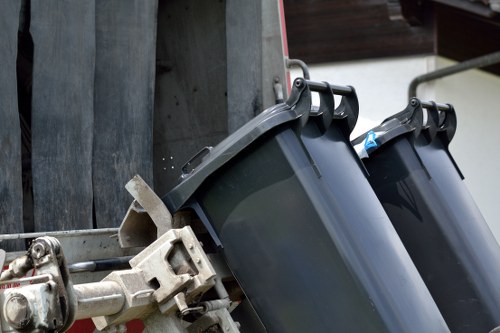
 Operational controls and safe systems of work include clear site assessment on arrival, establishing safe walking routes, securing loads, using appropriate containment (bags, bins, skips), and ensuring correct waste transfer documentation where required. Vehicles must be roadworthy and checked daily; mechanical lifting aids should be used to reduce manual handling strain. Special care is taken when working in multi-occupancy buildings or confined spaces to protect residents and operatives alike.
Waste classification and disposal requirements are strictly observed. Prohibited items that cannot be accepted by standard clearance crews—such as certain chemical wastes, large quantities of asbestos-containing materials, and clinical or pharmaceutical waste—are identified and segregated. The policy promotes reuse and recycling where possible and requires compliance with relevant environmental controls when transferring waste to authorised treatment or disposal facilities.
Incident reporting and investigation: any injury, near miss, spill or environmental release must be reported immediately and recorded. The response includes first aid, containment, notification to supervisors, and where appropriate, investigation to identify root causes and corrective actions. Lessons learned will be shared across the team and used to update risk assessments and procedures to prevent recurrence.
Monitoring and performance: the company will carry out regular audits, site inspections and health and safety reviews to monitor compliance with this policy and associated procedures. Metrics such as incident rates, training completion, vehicle defect reports and audit findings will inform continuous improvement. External inspections and statutory obligations will be met and records retained in accordance with applicable rules.
 Review and continuous improvement: this Health & Safety policy is reviewed at planned intervals and whenever significant changes to operations, legislation or incident learnings arise. The aim is to maintain a robust safety management approach that protects people and the environment while delivering reliable and efficient house clearances and rubbish collection services. By embedding safety into everyday practice, the company demonstrates its ongoing commitment to safe, responsible clearance work across its service area.